
7 KYC Platform Providers Product Managers Must Consider in 2025

For years, Know-Your-Customer (KYC) has been a critical business function that protects companies from fraud while shaping the earliest moments of the customer experience. Product managers must treat it as such.
Today, the stakes are higher than ever:
- Conversion Risk: An estimated 63% of potential customers abandon digital onboarding due to friction. The process is too slow
The right KYC platform providers are now a strategic growth lever. These providers streamline customer acquisition by reducing onboarding friction and accelerating verification, enabling businesses to onboard new customers faster and more efficiently. They don’t just reduce identity fraud and ensure audit-ready compliance. Modern KYC platforms also help reduce compliance costs by automating verification and streamlining regulatory processes.
Choosing a vendor today is a critical decision that directly impacts your conversion, global expansion, and defense against future AI-driven fraud threats. The following providers stand out in 2026 for their capabilities and practical usefulness.
How to Evaluate Top KYC Platform Providers for Identity Verification?
Choosing a KYC provider is a strategic product decision. It affects your conversion rates, global growth, and fraud exposure. Use these five pillars to guide your evaluation: A streamlined compliance process is essential, as it ensures the KYC platform provider can help you efficiently meet complex regulatory requirements and integrate verification workflows.
1. Integration Simplicity and Time-to-Market
For a product team, integration speed is crucial.
- Look for speed: Test the platform’s SDK maturity and API documentation. Can your developers roll it out in days, not weeks?
- Check the sandbox. The testing environment must be robust and mirror the real world.
- Demand flexibility: Does the platform support low-code or no-code configuration? This lets non-tech users (Compliance, Risk) build workflows without needing engineering help.
- Leverage automated compliance solutions: These reduce manual compliance tasks and accelerate deployment, improving operational efficiency.
- Get real-time updates. Ensure the platform uses webhook flexibility for instant status changes.
2. Customer Onboarding, Friction, and Conversion Rates
The onboarding flow must be seamless for the user.
- Test the UX/UI. The verification journey should be mobile-first and user-friendly. High friction means drop-offs.
- Leverage an effective customer identification program. A well-designed customer identification program streamlines onboarding by efficiently collecting and verifying customer identity, reducing friction for new users.
- Demand high accuracy. Low error rates and reliable verification accuracy reduce false positives and the need for frustrating manual reviews.
- Check latency. How fast is the verification time? Speeds under 30 seconds are becoming the industry standard.
- Evaluate global reach. Does the provider support all document templates and languages for your target markets?
3. Future-Proofing and Fraud Prevention Signals
The platform must constantly evolve to fight new fraud methods.
- Look for AI/ML. Does the platform use AI-driven fraud signals and advanced biometric verification (like 3D liveness detection) to detect fraud in real time using advanced analytics?
- Examine the roadmap. What is the provider adding in the next 12 months? They must prioritize new verification technologies.
- Ask about blockchain. Some top platforms offer blockchain-secured audit trails for immutable (unchangeable) logging.
4. Transparency and Case Management
Your Compliance and Product Analytics teams need clear data.
- Require granular dashboards. The platform must report on key metrics like pass rates by market, document type, and device.
- Verify audit trails. Can you easily export audit logs? This is essential for regulatory compliance.
- Integrated diligence solutions can further enhance transparency and support effective case management by providing comprehensive KYC and risk management services.
- Check configuration. Can you assign risk scores, set up watchlist filters, and track why a reviewer made a decision?
5. Regulatory Compliance, Security, and Data
Compliance and security cannot create a bottleneck. A modern KYC platform should go beyond identity checks and actively support data compliance by enforcing consistent data standards, auditability, and clear ownership across verification workflows.
- Demand compliance. The platform must be current with global regulations like GDPR, AML/PEP screening, and sanctions lists, and should offer robust AML solutions and KYC compliance features to ensure comprehensive, automated, and up-to-date adherence to regulatory requirements. It should also support efficient KYC verification, allowing businesses to quickly and accurately verify customer identities while maintaining regulatory standards.
- Review data handling. Ask about data residency options, encryption methods, and privacy controls during storage and transfer.
- Maintain compliance. Ongoing monitoring and regular updates are essential for maintaining compliance with evolving regulatory standards, ensuring that identity verification, fraud prevention, and AML/KYC procedures continuously meet legal obligations.
- Check support. Responsive support teams are vital when a high-risk case or technical issue threatens your launch timeline.
The following seven providers stand out in 2025 for their capabilities, global reach, and practical usefulness to teams building digital products.
KYC Technology and Trends to Watch in 2025
As we move into 2025, the landscape of KYC technology is rapidly evolving to meet the growing demands for regulatory compliance, financial security, and seamless customer onboarding. Product managers and compliance leaders should be aware of several key trends that are set to redefine how financial institutions and regulated businesses approach identity verification and risk management.
Biometric verification and authentication are becoming the gold standard for verifying customer identities. Advanced methods such as facial recognition, fingerprint scanning, and voice authentication are being widely adopted to combat identity theft and ensure data integrity. These technologies not only enhance security but also streamline customer onboarding by providing a frictionless and efficient verification process.
The integration of artificial intelligence (AI) and machine learning (ML) into KYC solutions is another major trend. AI-powered identity verification services can analyze vast datasets in real time, improving risk assessment and fraud detection. This enables financial institutions to identify potential risks, detect fraudulent activities, and maintain robust compliance solutions, all while reducing false positives and manual review workloads.
Digital identity verification is also gaining momentum, offering a secure and scalable way to verify customer identities across global markets. These solutions can be seamlessly integrated with existing systems, helping organizations streamline customer onboarding and ensure ongoing compliance with evolving regulatory requirements.
Continuous ongoing monitoring and transaction monitoring are now essential components of modern KYC processes. With the rise of sophisticated financial crime and money laundering tactics, organizations are investing in advanced tools for adverse media screening and real-time risk intelligence. This proactive approach allows for the early detection of suspicious activities and ensures that customer relationships are regularly reviewed to reflect changing risk profiles.
As KYC regulations and anti-money laundering (AML) requirements continue to evolve, financial institutions must adopt scalable solutions that can adapt to new compliance landscapes and support growing customer bases. The right KYC provider will offer comprehensive global coverage, robust verification systems, and advanced risk management features to help organizations stay ahead of emerging risks.
In 2025, success will depend on a proactive, technology-driven approach to KYC and AML. By leveraging the latest advancements in biometric authentication, AI-powered identity verification, and continuous monitoring, organizations can enhance operational efficiency, ensure regulatory compliance, and deliver a superior customer experience. Investing in comprehensive KYC solutions and advanced fraud prevention tools will be critical for protecting financial systems, maintaining customer satisfaction, and securing a competitive edge in an increasingly complex regulatory environment.
Top 7 KYC Platform Providers for Product Managers
Selecting a suitable solution requires clarity on your business goals, risk appetite, regulatory scope, and expected onboarding volumes. No single platform fits every use case, which is why it’s important to compare providers based on several factors, especially workflow flexibility, geographic coverage, technical maturity, and pricing transparency. Robust verification processes are essential, and the ability to support both individual customers and business entities ensures comprehensive KYC and KYB coverage.
1. Ondato
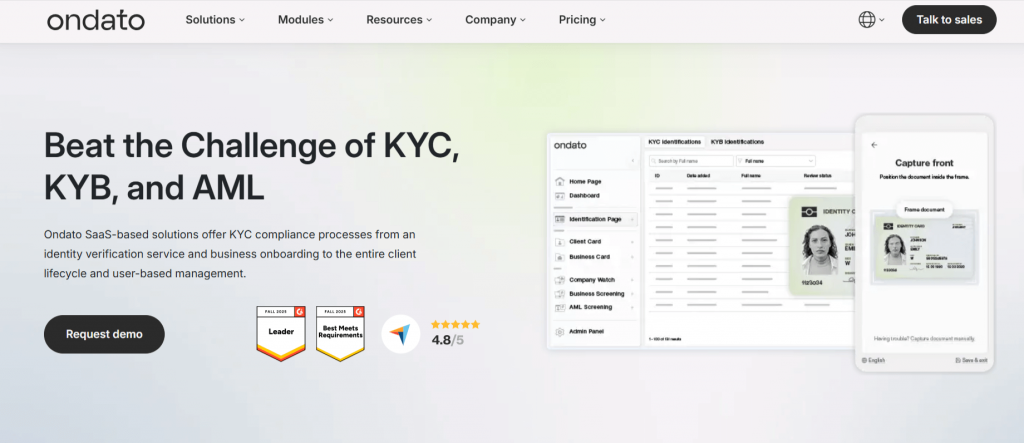
Ondato provides configurable KYC, KYB, and AML workflows designed primarily for regulated financial services and institutions requiring strong audit trails. The platform includes identity verification, business verification, transaction monitoring (via partner integrations), and compliance reporting. Ondato also offers due diligence solutions for comprehensive risk management and regulatory compliance, helping organizations verify customer identities, assess risks, and adhere to evolving regulatory requirements.
Features
- KYC service provider with robust compliance solutions
- Configurable KYC, KYB, and AML workflows
- Identity verification
- Business verification
- Transaction monitoring (via partner integrations)
- Compliance reporting
- Strong audit trails suitable for regulated industries
- Detailed workflow control
- Robust reporting features
- Regulatory depth suited for financial services
- Robust verification system offering reliable, secure, and efficient KYC and fraud prevention
- Serves global clients with a strong EU presence
Pricing
- Pricing depends on verification complexity, volume, and market
- Identity checks typically range from €1.40 to €0.50 per check
- KYB onboarding packages start from €600 per month
Managing complex KYC workflows? Stay aligned with Nifty
Get Started
2. ComplyCube
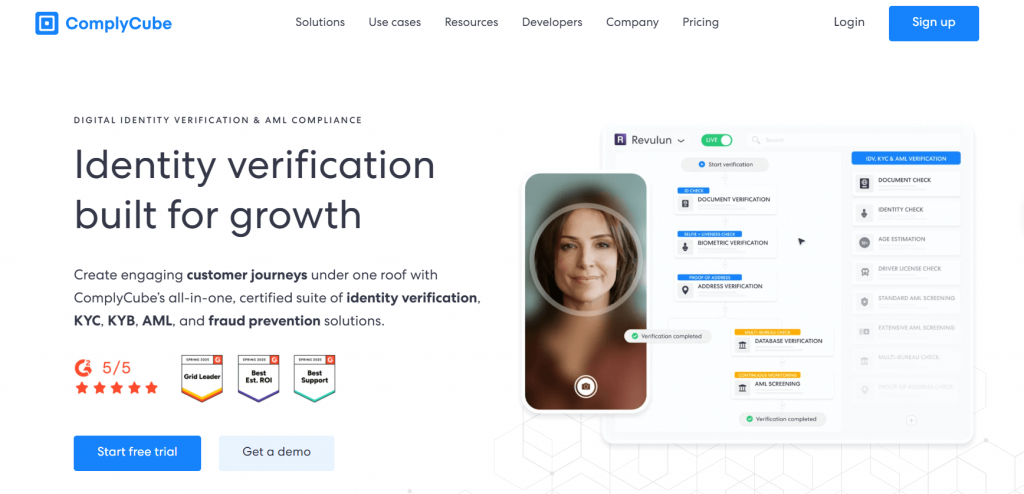
ComplyCube is an integrated identity verification and AML automation platform that combines document checks, biometric face matching, and global watchlist screening in one environment. As a leading identity verification solution, ComplyCube enables secure digital onboarding and ongoing compliance for businesses seeking robust customer validation and fraud prevention.
It is well known for its developer-friendly tools and clear API documentation, which help engineering teams move from testing to production quickly and with minimal friction.
Features
- Document checks
- Advanced document verification for secure and seamless online identity validation
- Biometric face matching
- Global watchlist screening
- Developer-friendly tools
- Clear API documentation
- Quick transition from testing to production
- Modular features for flexible onboarding
- Continuous monitoring (available in tailored plans)
- Custom assurance levels (enterprise plans)
- Suitable for both small and large teams
- May require additional tools for more complex onboarding pipelines.
Pricing
- Transparent per-check pricing for:
- Identity verification
- Watchlist screening
- Enhanced screening options
- Services can be purchased individually
- Enterprise-level bundled plans are available
- Tailored options include continuous monitoring and custom assurance levels
3. Veriff
Veriff focuses on automated identity verification with an emphasis on fraud detection and global document coverage. Veriff’s advanced ID verification capabilities ensure secure onboarding and help organizations meet regulatory compliance requirements. Its system supports a large library of identification documents and uses multiple layers of analysis to approve or reject verifications with minimal customer friction.
Features
- Automated identity verification
- Strong fraud detection capabilities
- AI-driven fraud prevention solutions for real-time monitoring and compliance with AML/KYC regulations
- Large global document library
- Multiple layers of analysis for verification decisions
- Minimal customer friction during verification
- High accuracy across diverse document types
- Broad global coverage
- May require configuration for niche markets or rare document types
- Enterprise-level support with customizable service agreements
Pricing
- Pricing varies by verification volume and automation level
- Basic automated checks start at $0.8 per verification
- Hybrid verification options start from $1.39 per check
- Enterprise customers can negotiate custom rates and service-level agreements
- Predictable pricing for small and medium-sized businesses
- Larger clients may need to go through a sales process for final pricing
4. iDenfy
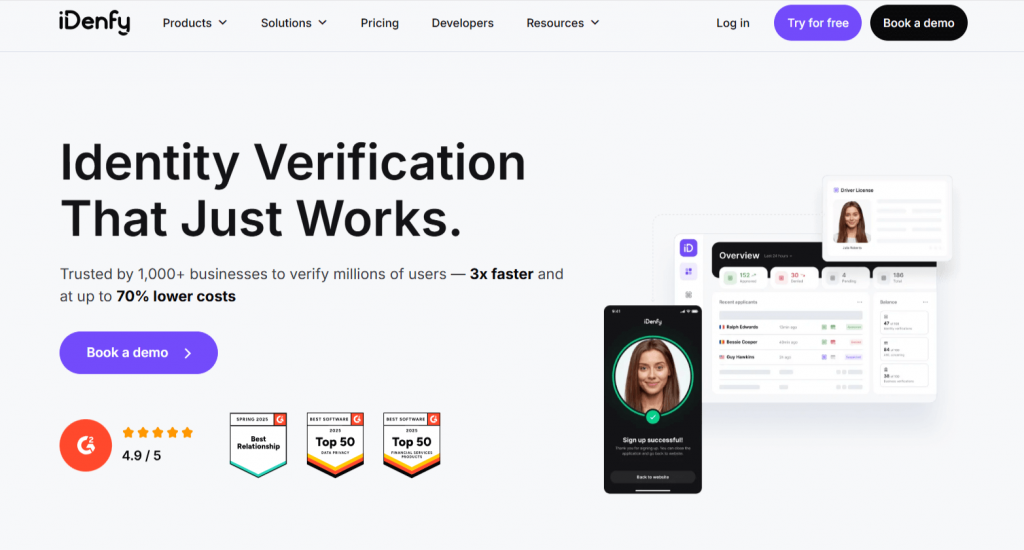
iDenfy provides identity document authentication, liveness detection, biometric face matching, and fraud detection tools aimed at fast, accurate verification. iDenfy specializes in verifying a wide range of government-issued identity documents, such as passports and driver’s licenses, to ensure customer authenticity and regulatory compliance. It is known for its straightforward integration process and support for many document types across a wide range of countries.
Features
- Identity document authentication
- Liveness detection
- Biometric face matching
- Fraud detection tools
- Customer due diligence for risk assessment and ongoing regulatory compliance
- Straightforward integration process
- Supports many document types across numerous countries
- Simple onboarding
- Accessible developer tools
- Predictable pricing structure
- May require additional regional data sources in certain markets
- Smaller selection of advanced AML features compared to larger competitors
Pricing
- Transparent pricing model
- Verification rates decrease as volume increases
- Enterprise customers can opt for:
- Enhanced service levels
- Dedicated support
- Additional verification modules
- Practical for medium-sized businesses seeking predictable costs
5. Trulioo
Trulioo operates one of the largest global identity networks, offering both KYC and KYB data sources. Its GlobalGateway platform is widely used by businesses that require reliable verification across multiple countries, including markets with diverse and challenging document types. Trulioo also enables businesses to screen for politically exposed persons (PEPs) as part of its risk assessment and compliance processes.

Features
- One of the largest global identity networks
- KYC and KYB data sources
- GlobalGateway platform for multi-country verification
- Leading KYC software platform for efficient customer and business verification
- Supports diverse and challenging document types
- Ideal for businesses expanding internationally
- Suitable for operations across multiple regulatory environments
- Deep regulatory data coverage
- Unparalleled global reach
- May involve longer procurement cycles
- Complex setup for smaller teams seeking upfront clarity
Pricing
- No simple per-check pricing is published
- Pricing varies based on:
- Country coverage
- Selected data sources
- Verification modules
- Designed for businesses operating across diverse regulatory markets
- More complex pricing structures may require detailed discussions
- Longer procurement process, especially for smaller teams
Scaling globally? Keep teams in sync with Nifty
Get Started for Free
6. Jumio
Jumio offers automated identity verification powered by document checks, biometric matching, and liveness detection. It is commonly used in industries that require both speed and strict fraud controls, including payments, cryptocurrency, and fintech. This level of security is necessary to prevent a fraudster from exploiting high-speed transaction environments.

Features
- Automated identity verification
- Document checks
- Biometric matching
- Liveness detection
- Strong fraud controls
- Suitable for payments, cryptocurrency, and fintech
- Robust reporting features
- Enterprise-level scalability
- Helps estimate savings through total cost of ownership tools
- Pricing details require submitting planning specifics (not ideal for small teams)
Pricing
- Pricing is fully customized
- Costs depend on:
- Mix of automated checks
- Manual review requirements
- Verification volume
- Offers tools to calculate total cost of ownership
- Pricing details are usually shared after the planning-phase submissions
- May not be attractive to small teams or early test deployments
7. Onfido (now Entrust)
Onfido delivers identity verification using document checks and machine learning based biometric comparison. The platform aims to reduce friction for customers while maintaining strong verification accuracy across multiple document types. Onfido incorporates liveness verification to prevent fraud, such as deepfake attacks, and to ensure that biometric authentication accurately confirms the presence of a real, live individual.
Features
- Document checks
- Machine learning–based biometric comparison
- Low-friction verification experience
- Strong verification accuracy
- Supports multiple document types
- Advanced machine learning models
- Strong support options
- Broad document coverage
- May involve resubmission fees
- Minimum contract thresholds can affect small teams or pilot projects
Pricing
- Custom pricing model
- Pricing depends on:
- Verification volume
- Geographic coverage
- Required verification modules
- Buyers should note:
- Possible resubmission fees
- Minimum contract commitments
- No public per-check pricing available
- Higher minimums may be challenging for small-scale or pilot deployments
Your Final Takeaways: The Strategic Choice
Selecting your KYC platform provider is a strategic decision that directly impacts growth, not just compliance.
Focus on Actionable Insights:
- Measure Real Performance: Test providers side-by-side. Track pass rates, false positives, and user friction—don’t rely on promises.
- Evaluate Total Cost: Look beyond the price per verification. Consider the total cost of ownership and the integration effort required by your engineering team.
- Align Teams: Ensure product, compliance, and engineering teams agree on the final choice to avoid future bottlenecks. For efficient internal stakeholder alignment, consider leveraging dedicated agile collaboration tools.
- Test for Growth: Validate the platform’s performance in new markets and its resilience against modern, sophisticated fraud attempts.
The right platform empowers efficient onboarding, reduces regulatory risk, and becomes a powerful growth lever for your business.
FAQ (Frequently Asked Questions)
Q1. What is a KYC platform, and why is it important for product managers?
A KYC platform helps businesses verify the identities of their customers (and sometimes businesses) to prevent fraud, money laundering, and regulatory violations. For product managers, choosing the right KYC solution is critical because it impacts customer onboarding, conversion rates, global expansion, and overall compliance.
Q2. How do KYC platforms reduce customer onboarding friction?
Top KYC platforms streamline identity verification through automated document checks, biometric matching, and AI-driven fraud detection. Features like mobile-first verification, low-latency processing, and a clear UX/UI help minimize drop-offs during onboarding, improving conversion rates.
Q3. What factors should I consider when evaluating KYC providers?
Product managers should evaluate providers based on:
- Transparency, reporting, and audit trail capabilities
- Integration simplicity and developer tools
- Speed and accuracy of verification
- Fraud detection capabilities and future-proofing
- Compliance and regulatory coverage
Q4. How much does it cost to use a KYC platform?
Pricing varies by provider, verification volume, and complexity. Some platforms charge per identity or business check (ranging from €0.50–€1.50 per check), while enterprise solutions may have subscription or custom pricing models. It’s important to consider total cost, including integration and ongoing operational efforts.
Q5. Can KYC platforms support global operations?
Yes, leading providers like Ondato, Trulioo, and Veriff offer global coverage, supporting multiple document types, languages, and regional compliance requirements. When expanding internationally, it’s essential to ensure the platform can handle local regulatory standards and diverse customer identification methods.